
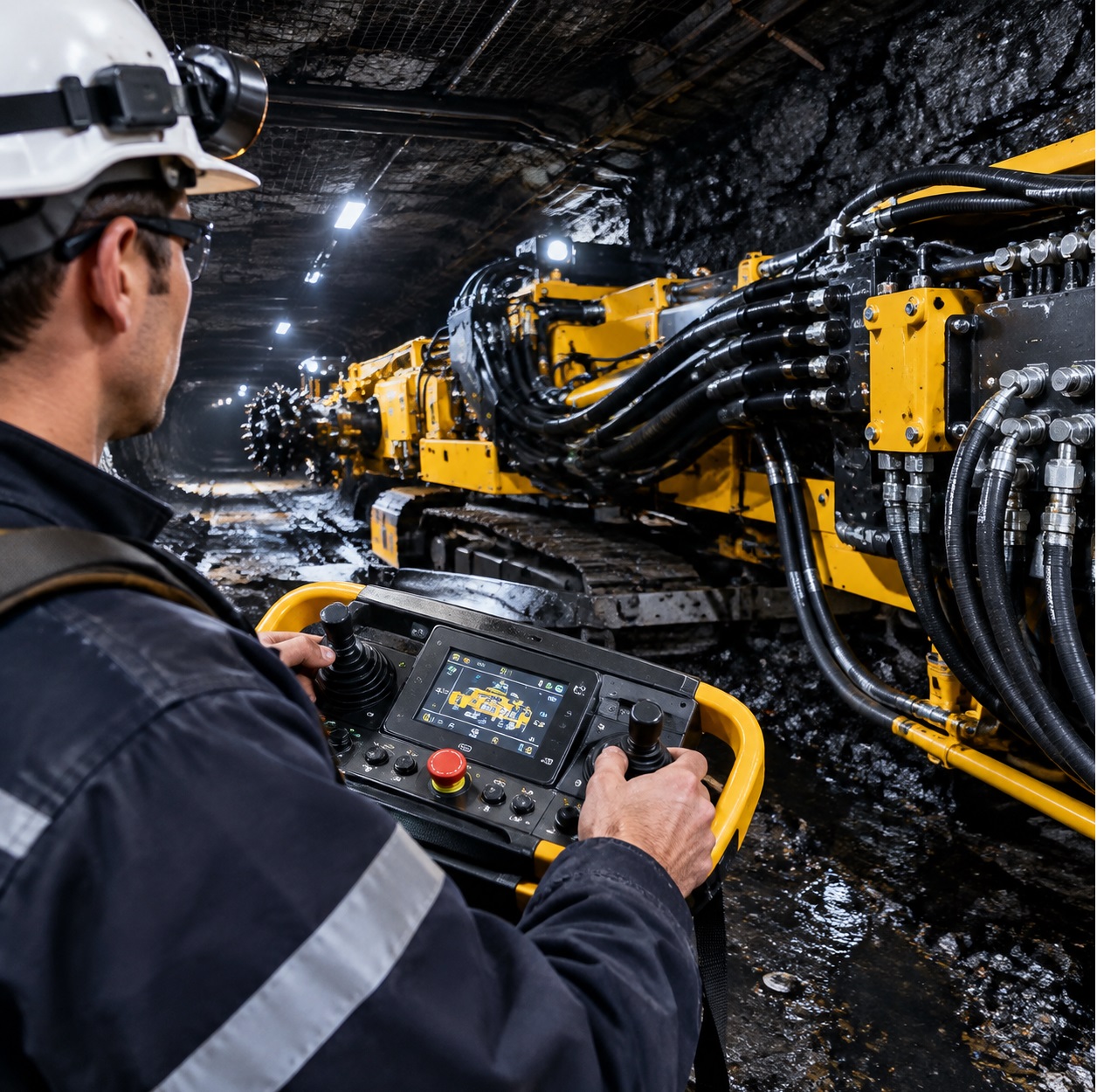
 The most expensive piece of equipment in your mine isn’t the shearer or the longwall shield. It’s the guy standing next to it, hand on a lever, breathing coal dust in a spot where the roof could shift without warning. That’s the real cost of doing things the old way.
Remote hydraulic control is changing that math. And if you’re still running manual valve banks on your shields, conveyors, or roof supports, you’re leaving money, uptime, and people on the table.
Here’s what’s actually happening underground when you move the controls away from the coal face.
First, the safety angle. Everyone talks about it, but let’s be specific. When a hydraulic valve fails or a hose bursts, the person closest to it takes the hit. Remote operation puts distance between your operators and the high-pressure side of the system. That distance isn’t just a safety metric on a spreadsheet. It’s the difference between a maintenance ticket and a fatality report. Mines that have made the switch consistently report fewer lost-time incidents in the face area. That alone justifies the investment for most operators.
But safety is only half the story. The efficiency gains are where the numbers get interesting.
Think about how much time your crew wastes walking between manual control stations. A longwall face is hundreds of meters long. An operator adjusting shields one by one, moving from station to station, burns hours every shift just on travel. With remote hydraulic control, one operator at a centralized console can sequence an entire section. What used to take three people two hours now takes one person twenty minutes. Multiply that across three shifts, seven days a week, and you’re looking at thousands of man-hours recovered every year.
Then there’s the precision problem. Manual hydraulic control is imprecise by nature. You crack a valve, you watch the pressure gauge, you feather it. Every operator does it slightly differently. That inconsistency causes wear on cylinders, stress on hoses, and uneven roof support that creates problems down the line. Remote systems with proportional control and feedback sensors deliver repeatable, measured actuation every single time. Your equipment lasts longer. Your maintenance windows shrink. Your unplanned downtime drops.
I’ve seen operations cut hydraulic component replacements by nearly 40 percent after switching to remote control with pressure monitoring. That’s not a marketing number. That’s a maintenance log.
Now, the practical question every mine manager asks: what does it take to implement this?
You don’t have to rip out your entire hydraulic infrastructure. Most remote control systems are designed to interface with existing valve banks and cylinders. The retrofit usually involves three pieces: electrohydraulic actuators or pilot valves at the control point, a communication backbone (often fiber or ruggedized Ethernet), and a control interface at the operator station. On newer equipment, this is often built in from the factory. On older gear, it’s a staged upgrade that can be done section by section during scheduled maintenance windows.
The communication backbone is where mines get nervous. Underground is a harsh environment for any signal. But modern industrial wireless and leaky feeder systems handle the conditions fine. The key is redundancy. Run your control signals over a wired backbone with a wireless fallback, and you won’t have operators staring at a dead screen mid-cycle.
What about the human side? Retraining is real. Operators who’ve spent twenty years reading gauges and feeling valve feedback need to learn a new interface. The good news is that most remote systems are designed to mimic the manual control logic. The learning curve is measured in days, not months. And younger hires who grew up with touchscreens pick it up almost instantly.
Let’s talk about the data layer, because this is where remote hydraulic control goes from efficiency tool to strategic asset.
Every actuation, every pressure reading, every cycle time is now a data point. You can see which shields are working harder than others. You can predict when a pump is about to fail based on subtle pressure trends. You can optimize your cutting sequence based on real cycle data instead of operator intuition. This isn’t theoretical. Mines running remote hydraulic control with integrated telemetry are catching equipment failures days before they happen. That’s the difference between a planned swap and a production-stopping breakdown.
The upfront cost is real. Depending on the scale and condition of your existing equipment, you’re looking at a capital outlay that ranges from modest to significant. But run the numbers on reduced labor, lower maintenance, fewer safety incidents, and higher production availability. The payback period is usually under two years. In some high-production operations, it’s under twelve months.
One more thing. Remote hydraulic control isn’t just about moving levers from point A to point B. It’s about changing the way your mine thinks about the face. When your operators aren’t physically tethered to the equipment, you can rethink your entire workflow. You can run leaner crews. You can rotate people through different roles without retraining on every manual station. You can keep production running during shift changes because the control room never stops.
The underground coal industry has been slow to adopt digital control compared to other sectors. That’s changing fast. The mines that move first are already seeing the gains. The ones that wait will be playing catch-up in a market that doesn’t reward hesitation.
If you’re evaluating remote hydraulic control for your operation, start with a single section. Measure everything before and after. You’ll have your answer within one quarter. And you’ll probably wonder why you didn’t do it sooner.